
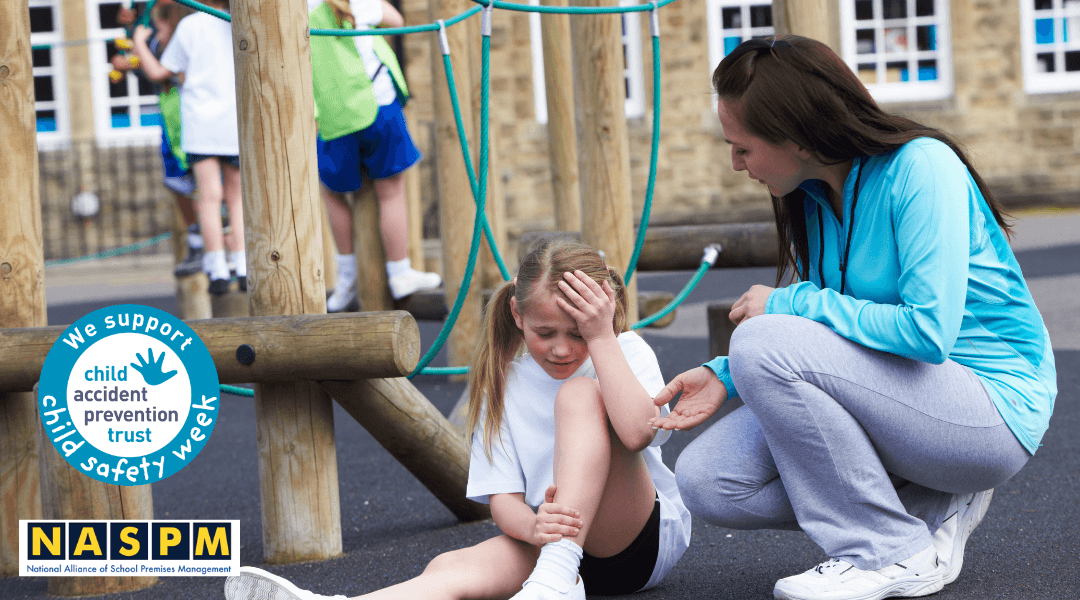
Child Safety Week rightly brings attention to the everyday risks children can face at home, online, on the move and in their wider lives.
Led by the Child Accident Prevention Trust, Child Safety Week 2026 runs from Monday 1st to Sunday 7th June and is designed to help families build confidence and skills in managing real risks to children’s safety. Source: Child Accident Prevention Trust, Child Safety Week.
That focus matters. But child safety belongs in every place children spend their day.
For schools, that means looking not only at policies and supervision, but at the buildings, grounds and shared spaces pupils use every day. Much of that safety work happens quietly: through routine checks, clear reporting, safe contractor management, fire safety routines, playground checks, housekeeping, maintenance and the everyday judgement of premises teams.
It may be behind the scenes, but it is part of what keeps children safe.
Why school premises must be part of the safety conversation
The condition and management of school buildings is not a small issue.
HSE data shows that 50,058 injuries in primary and secondary schools were reported over a five-year period. Around 70% involved non-employees, such as pupils, and slips, trips and falls accounted for around 40% of all reported injuries. Source: Health and Safety Executive, School trips: statistics.
The wider condition of the school estate also shows why premises safety needs serious attention. The Education Select Committee reported that around 700,000 pupils were learning in schools requiring major rebuilding or refurbishment due to safety or condition issues. It also cited National Audit Office analysis that 38% of school buildings, around 24,000 buildings, were beyond their estimated design life. Source: Education Select Committee, Replacing RAAC and securing school buildings.
These figures should not create fear, but they do show why premises management matters. Children spend a large part of their week in school buildings, and the safety of those buildings depends on consistent, practical management.
Safe premises is now a national expectation
This focus on safe school environments is also reflected in the Department for Education’s Education Estates Strategy.
The strategy sets out a clear direction for the education estate: it should be safe, suitable, sustainable and sufficiently sized. Under that vision, safe school buildings are not treated as a secondary concern. They are part of the foundation that allows children and young people to learn, develop and achieve. Source: Department for Education, Education Estates Strategy.
The DfE has also confirmed that, from autumn 2026, responsible bodies will be asked to make the first annual return through Manage Your Education Estate to confirm they are meeting the School Estate Management Standards. Source: Department for Education, Education Estates Strategy.
For school leaders, COOs, business managers and premises professionals, the direction is clear. Safe premises management is no longer just good practice. It is becoming part of how schools evidence that their estates are being properly managed, maintained and reviewed.
In other words, Child Safety Week and the Education Estates Strategy are pointing in the same direction. Safer children need safer school buildings.
Whole-school safety includes the site
A positive safety culture is not held by one person, one department or one policy.
It depends on shared responsibility. Staff need to know how to report concerns. Leaders need clear oversight. Premises teams need the time, tools and support to act. Contractors need to understand the site they are working in. Pupils need spaces that are properly managed around the realities of the school day.
The DfE’s good estate management guidance makes clear that schools need appropriate information, procedures and training in place for estate health and safety. It also notes that specific training may be needed for areas such as asbestos and fire safety. Source: Department for Education, Good estate management for schools.
That is why safe premises management should sit within a whole-school safety culture, not outside it.
The areas below are just a few examples of how premises management connects directly to child safety. They reflect the themes NASPM is focusing on during Child Safety Week, but they are not a full list of the risks, checks and responsibilities schools manage every day.
NASPM members can access a much wider range of practical resources through the Resource Hub, covering the everyday checks, records and compliance areas that help schools manage their sites with greater confidence.
Fire safety is not one check
Fire safety is one of the clearest examples of how child safety depends on connected premises routines.
It is not one alarm test or one drill. It includes emergency lighting, fire alarm testing, staff training, evacuation planning, servicing, records, higher-risk works controls, PEEPs where required and routine fire door inspections.
The NASPM Fire Checklist covers a wide range of fire safety records and checks, including fixed wire electrical inspections, emergency lighting paperwork, fire alarm testing, gas servicing, PAT testing, staff fire training, fire drill dates, evacuation plans, permits for higher-risk contractor works, evac chair servicing and monthly fire door inspections. Source: NASPM Fire Checklist, Document 77.
PE and playground safety needs safe spaces
Children need to move, play and take part in physical activity safely.
That relies on more than supervision. It also depends on equipment, outdoor surfaces, storage, reporting routines and regular checks that help identify issues before they cause harm.
Safe activity starts with safe environments. When equipment is checked, defects are reported and outdoor spaces are properly managed, schools are better able to support pupils as they move, play and take part in the school day.
NASPM’s PE and Playground Safety resource supports schools in managing the safe use of equipment and physical spaces, helping create a more consistent approach to safety across the site.
Slips, trips and falls are everyday risks
In a school, pupils move through corridors, halls, playgrounds, entrances, stairwells and shared spaces many times a day.
Small issues can quickly become risks in a busy environment: a wet floor, damaged surface, poor lighting, trailing cable, loose mat, blocked route or unreported defect.
HSE guidance on slips and trips in education identifies common causes including poor lighting, wet or contaminated surfaces, obstructions, bags and trailing cables. It also notes that education premises can be particularly busy, with large numbers of people moving around at the same time. Source: Health and Safety Executive, Slips and trips in education.
For schools, reducing those risks is not about removing every element of normal school life. It is about good housekeeping, timely maintenance, clear reporting and practical awareness across the site.
This is where a whole-school safety culture matters. Premises teams play a key role, but they cannot be everywhere at once. Staff need to feel confident reporting hazards, leaders need clear processes for escalation, and small issues need to be dealt with before they become bigger risks.
Premises and site safety includes the risks pupils never see
Some of the most important safety work in a school may never be noticed by pupils.
Asbestos management. Legionella controls. Contractor management. Servicing records. Statutory checks. Site documentation.
These areas may sit behind the scenes, but they are central to keeping the school environment safe. The risks may not be visible in the day-to-day life of a pupil, but they still need to be understood, managed and reviewed.
NASPM’s Resource Hub includes practical documents covering areas such as asbestos, legionella and contractor management, supporting schools with the compliance responsibilities that sit behind a safer site.
The work continues beyond Child Safety Week
Child Safety Week is a valuable moment to focus attention, but safe premises management is year-round work.
It happens in the morning walk-round. The fire safety record. The contractor induction. The playground check. The defect report. The housekeeping routine. The follow-up that makes sure an issue has not just been noted, but resolved.
For school leaders, the message is clear: child safety belongs in every place children spend their day, and that includes the school estate.
NASPM exists to support the people responsible for safe, well-managed school premises, with practical resources, guidance and a professional community built around the realities of the role.
Premium members can access hundreds of documents through the Resource Hub, from checklists and templates to guidance covering key areas of estates, compliance and day-to-day site safety.
Because schools must be safe.
Sources:
Child Accident Prevention Trust, Child Safety Week, CAPT, 2026.
Health and Safety Executive, School trips: statistics, HSE, 2024.
Health and Safety Executive, Slips and trips in education, HSE, 2025.
Department for Education, Education Estates Strategy: a decade of national renewal, GOV.UK, 16 February 2026.
Department for Education, The Education Estates Strategy: what it means for your school, Buying for Schools, 13 March 2026.
Department for Education, Good estate management for schools: health and safety, GOV.UK.
Education Select Committee, Replacing RAAC and securing school buildings, UK Parliament, 11 February 2026.