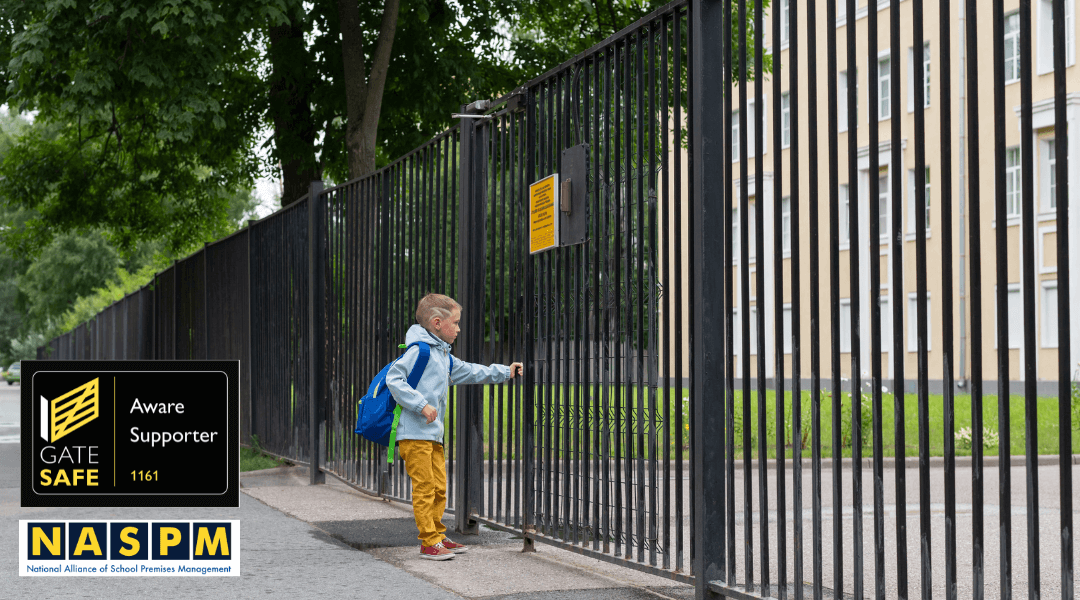
School Gates – Delivering Safety or a Safety Risk?
Automated gates have become a regular feature on the school site and for good reason, providing a strong show of physical defence and access control. However, these gates, when not installed or maintained correctly rather than delivering an extra layer of security can be construed as a major safety risk to pupils, staff and visitors. And in the unfortunate event of an accident occurring, the school headteacher can be held accountable.
Responsibility for the health and safety of pupils and staff lies with the employer. This is primarily delegated to the Headteacher and the school’s management team who must take reasonable steps to ensure that risks are effectively managed. Parliamentary Under-Secretary of State for the School System
Even if the HSE investigates and finds the negligence lies elsewhere, the ensuing negative publicity for the school can have a lasting impact.
A recent survey of school gates by Gate Safe – the charity which has been campaigning to raise awareness of the need to improve the standard of safety for automated gates and barriers since 2010 – revealed that a staggering number of gates in a school setting represented a clear safety hazard.
Gate Safe surveyed 87 electric gates for schools across the country and the findings are deeply concerning:
- 87% of the swing gates only featured two hinges – which is contrary to the Gate Safe guidance supported by the updated British Standard BS EN 12604 which states that swing gates should not be capable of falling through a single point failure – such as a hinge breaking. Only 12% featured the recommended three hinges while one school had gone the extra mile to fit a fourth hinge
- If a third hinge does not feature on the gate, a suitably robust fall arrest tether should be included in the installation but the survey revealed only 9% of the swing gates had been fitted with a tether to prevent the gate from falling
- Just over half of the gates reviewed only featured one pair of photocells (51%) which is inconsistent with providing the required level of non-contact safety. Furthermore, an alarming 3% of gates were not even fitted with photocells (magic eyes)
- 22% of gates – just under a quarter – were capable of hitting or crushing anyone who obstructed the gate if it was opening or shutting because the correct safety devices had not been fitted. The gate had either no safety edges or only one safety edge fitted, which work to ensure that in the event of contact, the gate would reverse away from the person. Safety edges were more commonly seen than photocells when schools should be prioritising non-contact safety ie photocells (or light curtains / laser scanners)
- Hinge protection to prevent the risk of entrapment was also lacking on 34% of gates, with either zero or only one hinge featuring this safety measure
In addition to the worrying evidence above, the survey also revealed that where safety edges were fitted, many were incorrectly sited or incorrectly programmed – and some were not even working.
All of these issues could result in a serious accident, as has already been witnessed by some of the following incidents:
- January 2010 – Bournemouth, three-year-old boy trapped his head between gate and post at a primary school
- September 2012 – Dudley, eight-year-old injured when head became trapped between gate and gate post
- April 2015 – Swansea – pupil injured at a primary school, incident involving gate
- Dec 2016 – Manchester, five-year old girl crushed by a 6ft iron gate which fell and caused serious injuries
- Nov 2017 – North Yorkshire, teaching assistant injured when a gate fell at school as a result of hinge failure
- May 2018 – London, eight-year-old girl crushed by a steel sliding gate when it fell
Schools have a clear responsibility to ensure any automated gate – which is legally classed as a machine – has been installed in line with best practice and is fitted with the relevant safety features to mitigate any risks which include impact ie crushing (either if the gate falls onto the victim or closes onto the victim), entrapment, shearing, dragging / drawing in, cutting or hooking. And it’s important to remember that where a school site features pupils under 16 years old, at this age they are deemed vulnerable users who are unable to apply logic and react to risks in the same way that an adult would.
Gate Safe’s advice to schools is simple. First and foremost, make sure that the decision to install an automated gate is the right one for the site in question. These gates come with a hefty price tag and the school should have the funds in place to pay the costs associated with fitting the correct safety features and the six-monthly maintenance checks by a professionally trained and competent installer. Invite a Gate Safe installer to site to ascertain the best security and access control solution for your school at the outset. You may find that a manual gate or barrier is a more appropriate – and cost effective – response.
Secondly, follow the Gate Safe “Safe School Gate” guidance:
Prior to installation a thorough risk assessment should be undertaken by a competent and suitably trained installer
- All automated gates and barriers should be fitted with at least two different types of safety devices / features. These must be correctly positioned and sufficient to mitigate or eliminate the risks associated with automated gates. Gate Safe recommends the use of photocells (or light curtains / laser scanners) and pressure edges
- All gates should be CE/UKCA marked. Full training should be given to staff at handover, including a manual specifically for the gates
- All gates and barriers must undergo routine maintenance every six months (or more if the gate has exceptionally high usage) by a suitably qualified and competent installer
- Relevant staff must be trained to understand how to place the gate into manual operation. Staff must be aware of, and have easy access to, the manual release keys
- Gates and barriers must be checked on a routine basis by a member of staff, follow the guidance in the checklist below.
Thirdly, make sure a member of staff is nominated to take responsibility for undertaking regular checks on any automated gates, Gate Safe has created a simple checklist for schools:
- Check any photocells are clear of plant debris or snow as this can block the beam and prevent the gate from operating
- Check for wear and tear around the posts / supports and the overall construction of the gate / barrier. Make sure the gate is operating smoothly
- Check the manual release procedure and ease of manual operation. Ensure staff continue to be aware of the procedure in the event of the gate breaking down and understand how to place it in manual operation to enable safe access and exit. If in doubt ask your maintenance company to demonstrate this for you on the next service maintenance visit
- Ensure the track and opening area of the gate is free of debris
- Consider any changes around the gate / barrier that could affect the safety and running of the gate i.e. new bin store being installed near the gate.
If you have any doubts about the safety of any school gates, contact a Gate Safe installer, you can find your nearest installer by visiting the website www.gate-safe.org/find-installers
Gate Safe has also created a dedicated guide to specifically help schools understand the importance of automated gate safety and the steps which must be taken to achieve a safe and compliant installation, which can be downloaded here.
Although an accident may not happen very often when it does there is a very high risk of serious injury…
Watch this space for more news in relation to Gate Safe’s dedicated Safe School Gate campaign.